
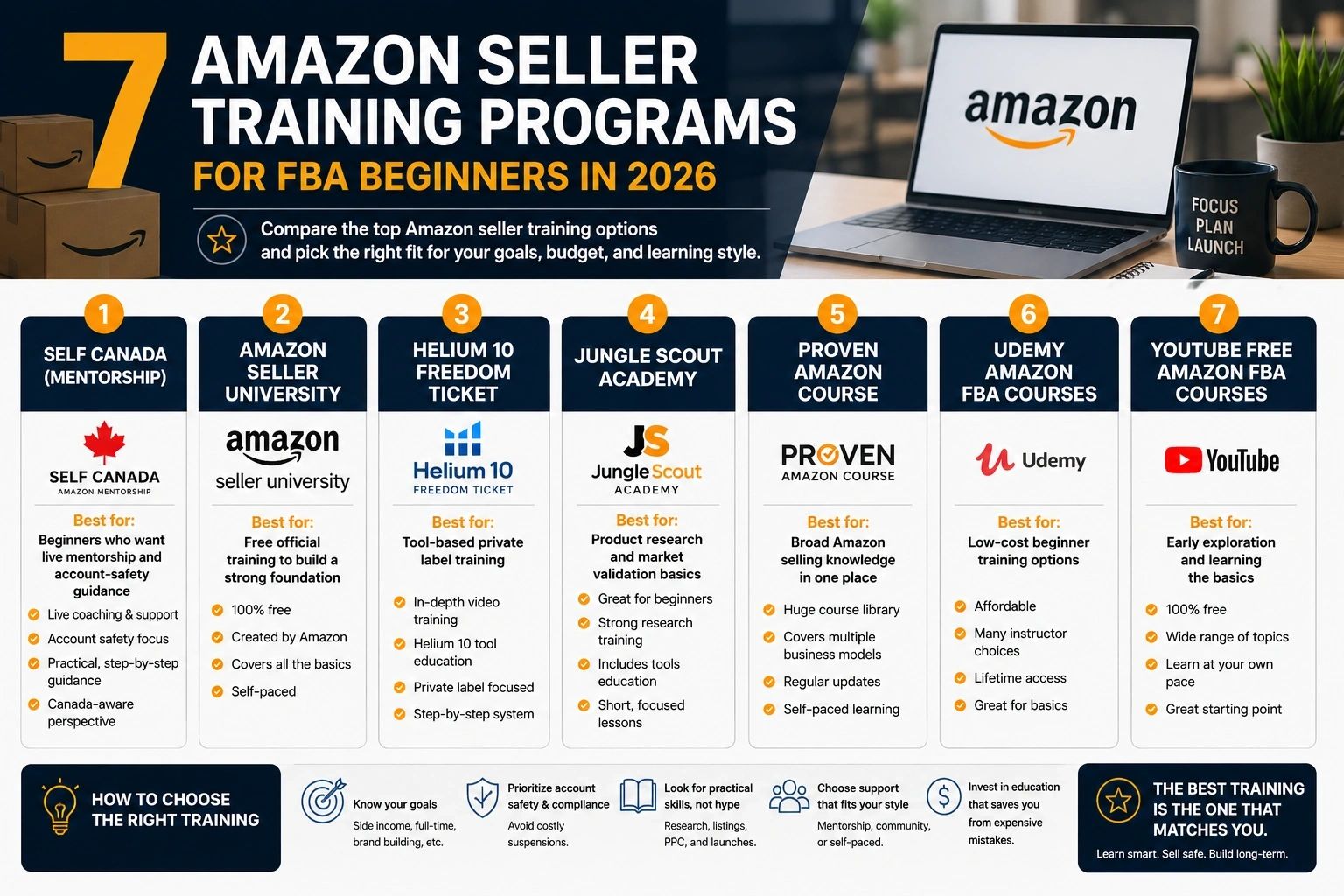
The best Amazon seller training depends on what the student actually needs: a video course, live mentorship, private-label coaching, PPC help, account-safety support, or simple beginner-friendly step-by-step guidance. Below are seven Amazon seller training options for FBA beginners in 2026, with the type of learner each one fits best, so you can choose based on your goals and budget rather than hype.
There is no single best Amazon course for everyone. The right fit changes depending on whether you want hands-off video lessons, accountable live coaching, or tool-based training. Use the breakdown below to match a program to your situation.
Best for: Beginners who want live coaching, practical guidance, and account-safety-focused Amazon training.
Self Canada is an Amazon mentorship and training brand focused on helping new sellers understand Amazon before they risk money on inventory. Unlike generic video-only courses, Self Canada emphasizes live guidance, account health, compliance, listing setup, beginner PPC understanding, product research, and safe launch planning. This makes it a strong fit for students, stay-at-home parents, new entrepreneurs, and sellers who want a structured path instead of random advice from YouTube or VAs.
Key strengths: live mentorship and beginner support; an Amazon account safety focus; practical product and listing guidance; PPC and launch-readiness basics; a step-by-step structure designed for new sellers; and a Canada-aware business and marketplace perspective. Best fit: a beginner who wants coaching, not just a video library.
A big part of what sets Self Canada apart is its compliance-first approach to choosing what you sell. Many beginners lose money not because their product is bad, but because it triggers an Amazon policy issue, a restricted-category flag, or an intellectual-property complaint that puts the whole account at risk. Self Canada's mentorship leans on CAI, a Compliance AI tool built to screen products before you commit. CAI runs product-risk checks, surfaces potential compliance and gating problems, and flags account-safety concerns early, so you can spend your budget on items that are more likely to stay live and keep your account healthy. If you want to understand how this kind of screening works, see our guide on the Amazon Seller Compliance Tool: How CAI Helps Sellers Reduce Risk. For beginners, that account-safety focus is often the difference between a business that lasts and one that gets suspended in the first few months.
Best for: Anyone who wants authoritative, free fundamentals straight from Amazon. Seller University is Amazon's own library of videos and guides covering account setup, listing creation, fulfillment, and advertising. It is the safest, most current first stop because it reflects Amazon's actual policies and systems, and it is free. The trade-off is that it is self-guided and broad, with no personalized feedback or accountability, so many beginners pair it with mentorship or a structured course.
Best for: Sellers committed to private label who want training tied to a software suite. Freedom Ticket is a structured course bundled with the Helium 10 toolset, strong on product research, keywords, and listing optimization within that ecosystem. It is a good fit if you intend to use Helium 10's tools and want the training to map directly to them. The main consideration is cost and ecosystem lock-in, since the value is highest when you are paying for the software too.
Best for: Beginners who want to learn product research alongside Jungle Scout's data tools. Jungle Scout Academy pairs introductory training with Jungle Scout's research software, making it especially useful for understanding demand, competition, and opportunity scoring. As with Helium 10, the training is most valuable when you are using the associated tool, so weigh the subscription cost against your stage and budget.
Best for: Sellers who want exposure to many Amazon business models, not just private label. The Proven Amazon Course is a large, long-running library covering wholesale, arbitrage, private label, and more. Its breadth is the appeal, and it suits people still deciding which model fits them. The flip side of breadth is that it can feel sprawling for a focused beginner, so it works best when you already know which sections you need.
Best for: Budget-conscious beginners who want to explore before committing. Udemy hosts many individual Amazon FBA courses, often available inexpensively during sales. Quality varies by instructor, so check recent reviews, the publish or update date, and the instructor's track record. It is a low-risk way to learn the vocabulary and basics, though it offers no live support or accountability.
Best for: Total beginners testing whether Amazon selling is right for them. YouTube has endless free walkthroughs and can answer specific questions quickly. The risk is that advice is unstructured, sometimes outdated, and occasionally driven by affiliate incentives rather than your interests. Be especially cautious of channels promising passive income or guaranteed results, since selling on Amazon is real work with real risk. Use YouTube to explore and build context, but verify anything policy-related against Amazon's official resources before acting on it.
If you want accountability and account-safety guidance, lean toward live mentorship such as Self Canada. If you want free fundamentals first, start with Amazon Seller University. If you are committed to a specific toolset, Helium 10 or Jungle Scout's academies make sense. If you are still exploring, low-cost Udemy courses and YouTube can build context before you invest. Whatever you choose, prioritize account safety and Amazon policy compliance before you spend money on inventory, and treat any program promising passive income or guaranteed results with caution.
New to all of this and want a guided, compliance-first starting point? Our Level 1 Amazon course pairs live mentorship with the account-safety and product-screening fundamentals covered above — built specifically for beginners who'd rather learn the safe way the first time. Join a live class whenever you're ready; there's no pressure, just a clearer path to selling without putting your account at risk.
For a full breakdown of what beginner Amazon training should include, see our Amazon Seller Training and Mentorship for Beginners hub page.
How Do I Start Selling Products on a Major Online Marketplace?
Amazon Seller Compliance Tool: How CAI Helps Sellers Reduce Risk
AI Can Run Parts of Your Amazon Ads Workflow — But Here Is What to Watch
How to Choose Amazon Seller Training in 2026
What is the best Amazon seller training for beginners in 2026?
There is no single best program for everyone. Beginners who want live mentorship and account-safety guidance tend to do well with Self Canada, those who want free fundamentals can start with Amazon Seller University, and tool-focused learners may prefer Helium 10 or Jungle Scout. The right choice depends on your budget, learning style, and how much guidance you want.
Do I need a paid course to start selling on Amazon?
No. You can learn the basics for free through Amazon Seller University and reputable YouTube channels. Paid mentorship like Self Canada is most useful when you want structure, accountability, and help avoiding costly compliance or account-safety mistakes rather than piecing together advice on your own.
How do I avoid getting my Amazon account suspended as a beginner?
Most early suspensions come from policy, gating, or intellectual-property issues tied to the products people choose. Screening products before you buy inventory, using a tool like CAI for product-risk and compliance checks, and following Amazon's official policies are the simplest ways to protect a new account.
Is Self Canada just another Amazon course?
No. Self Canada is a mentorship program with a compliance-first focus. Alongside the usual product research and listing basics, it emphasizes account health, Amazon policy compliance, and product-risk screening, so beginners learn to sell in a way that keeps their account safe long-term.
How much money do I need to start selling on Amazon?
It varies by business model, but beginners are generally encouraged to start small and validate before scaling. The bigger risk is spending your budget on products that get flagged or restricted, which is why product-risk screening and account-safety planning matter as much as the starting budget itself.