THE PRODUCT YOU DO NOT SOURCE MAY BE YOUR BEST AMAZON DECISION
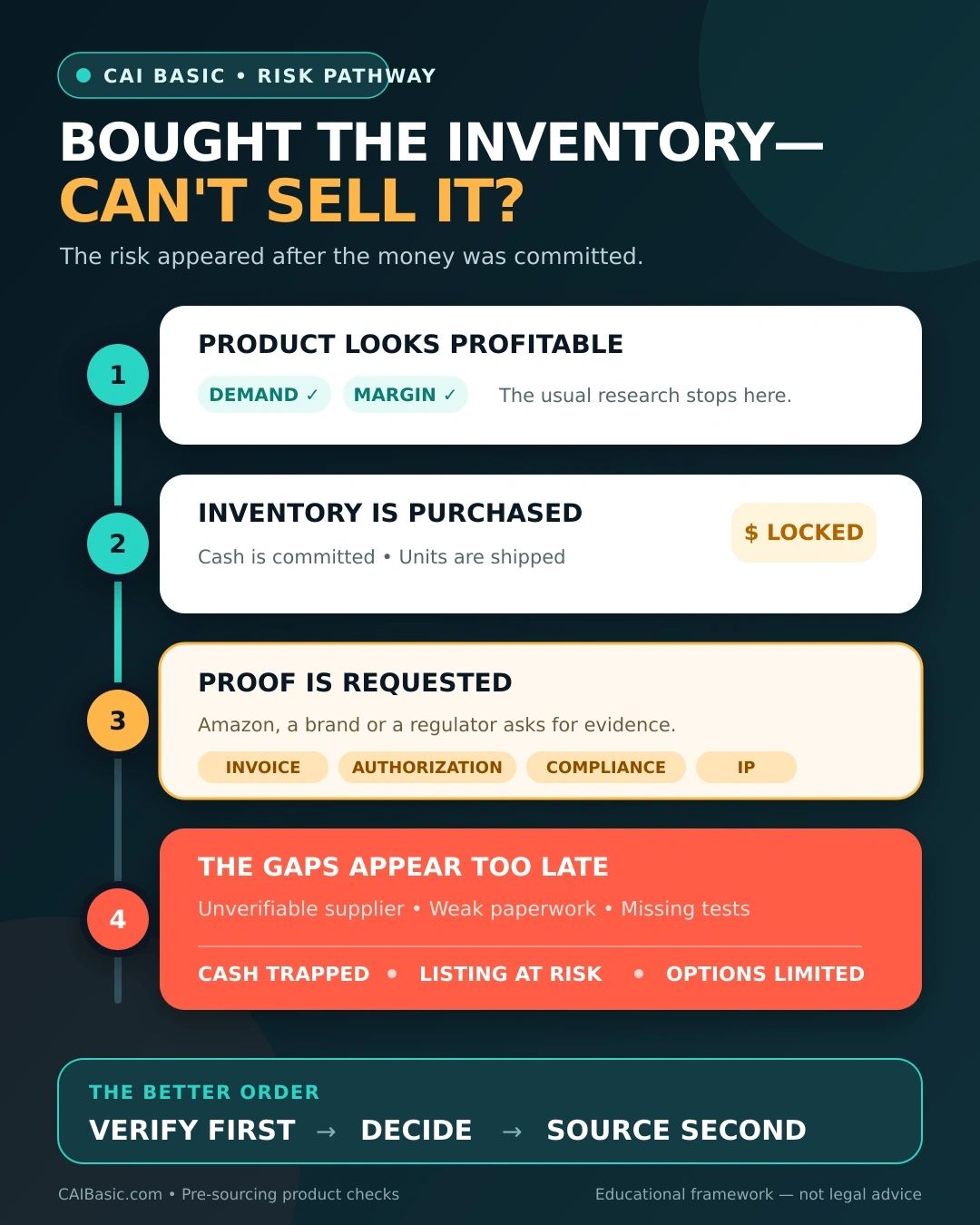
Imagine purchasing hundreds of units of a promising product—then discovering that your invoice is unacceptable, the supplier cannot prove authorization, essential compliance documents are missing, or the product presents an intellectual-property risk.
The inventory has already been purchased. Your money is already committed.
Most Amazon product research begins with two questions:
Does the product have demand? Can it generate a good margin?
My thesis is different:
A product is not a real opportunity until it passes a sourcing-risk test.
Demand is not permission. Profit cannot compensate for weak invoices, unclear intellectual-property rights, missing compliance documents, or an unverifiable supplier.
This matters because verification is becoming more important throughout global commerce.
The OECD and EUIPO estimated that counterfeit and pirated goods represented approximately US$467 billion—or 2.3% of global imports—in 2021.
Amazon reported that, in 2024, it identified, seized, and appropriately disposed of more than 15 million counterfeit products worldwide. Amazon also reported that its proactive controls blocked more than 99% of suspected infringing listings before brands needed to report them.
These figures do not mean every rejected product is counterfeit or that passing one check guarantees account safety. They demonstrate the scale of supply-chain and intellectual-property verification within modern marketplaces.
Before sourcing a product, sellers should investigate four areas:
- PERMISSION
A product can have excellent demand and still be affected by brand approval requirements, category restrictions, patents, trademarks, designs, copyrights, distribution agreements, or marketplace-specific rules.
- SUPPLIER EVIDENCE
A supplier is more than a price. Sellers must investigate the legal business, product origin, authorization, supply chain, and whether the resulting invoice could meet Amazon’s requirements.
- PRODUCT COMPLIANCE
Testing, certificates, labels, warnings, packaging, and responsible-party requirements vary by product and country. Trying to create documents after a listing problem appears may be too late—or the documents may not apply to that exact product.
- TRUE RISK-ADJUSTED MARGIN
Profit calculations should include landed cost, advertising, returns, storage, testing, documentation, compliance changes, and the financial cost of abandoning unsafe inventory.
The product showing the highest estimated margin may not be the best business decision.
I learned through years of Amazon selling—and through firsthand experience with account and compliance problems—that product risk must be investigated before inventory decisions are made.
That belief is behind CAI Basic.
CAI Basic is being designed to bring product, supplier, invoice, intellectual-property, compliance, and cost questions into one structured pre-sourcing review.
It cannot guarantee Amazon approval or replace Amazon, a lawyer, a testing laboratory, or professional judgment. Its purpose is to help sellers identify what still needs to be verified before committing their money.
The future of Amazon product research is not:
“Find a winning product, buy it, and investigate the risk later.”
It is:
“Understand the risk first, and then decide whether the opportunity is worth pursuing.”
Before placing your next order, ask:
Can I prove where this product came from? Can I establish whether I may sell it? Do I know which documents it requires? Do the numbers still work after meeting those requirements?
If the answer is unclear, pause.
That pause may be your most profitable Amazon decision.
Follow CAI Basic for early access to pre-sourcing product checks.
#AmazonSeller #ProductSourcing #AmazonCompliance #Ecommerce #CAIBasic