How Do I Start Selling Products on a Major Online Marketplace?
Selling products on a major online marketplace has become one of the most practical ways to build a scalable digital business. Unlike traditional retail, online marketplaces allow you to leverage existing traffic, logistics infrastructure, and customer trust—without the overhead of running a physical store. However, success requires structure, compliance, and a long-term strategy.
This guide outlines the foundational steps to start selling the right way—and how Self Canada supports sellers through a compliance-first approach.
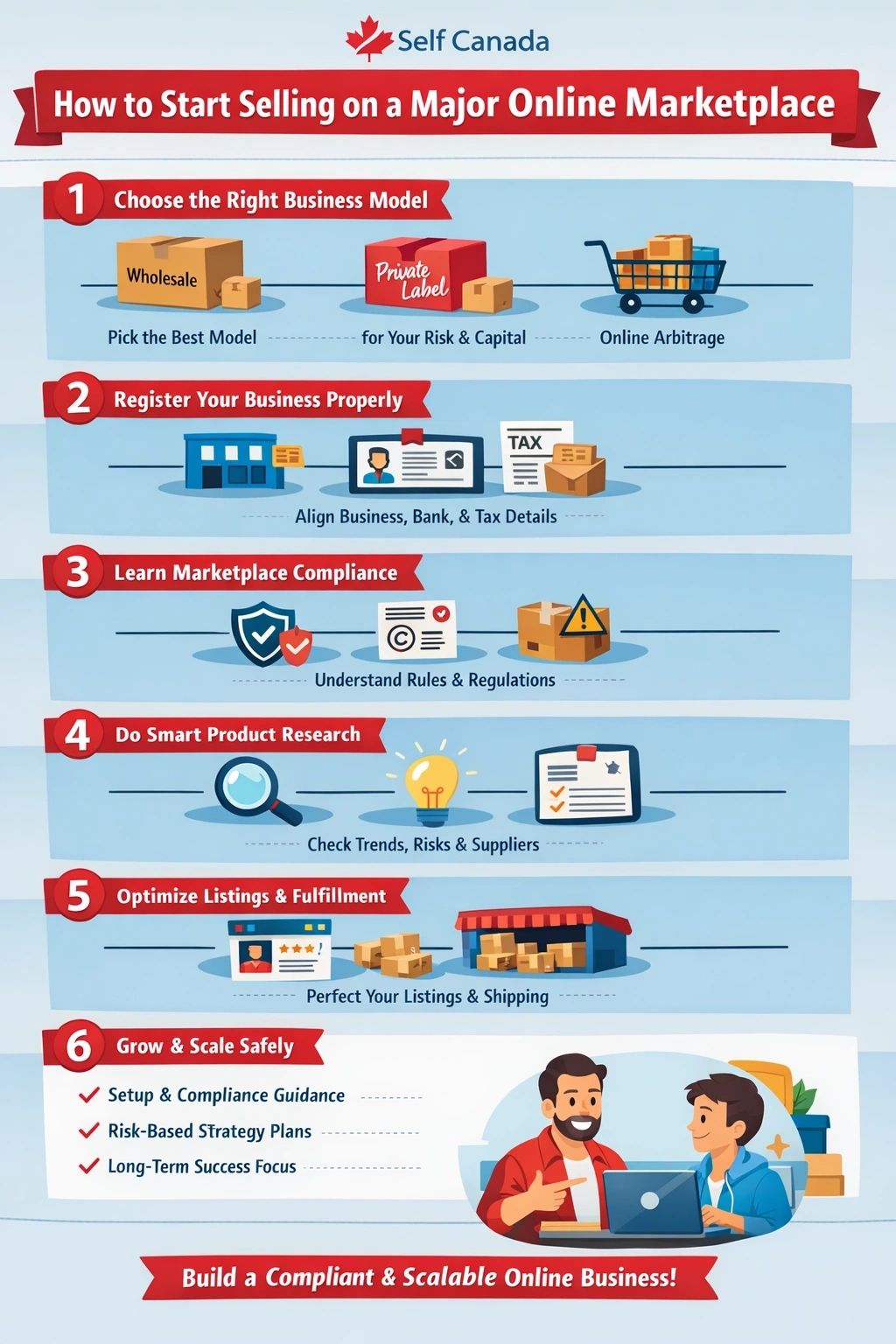
Before creating an account, you must decide how you will sell. Common marketplace models include:
- Wholesale – Selling branded products with authorization from suppliers
- Private Label – Selling your own branded products manufactured specifically for you
- Online Arbitrage – Reselling products sourced from online retailers (higher risk if done incorrectly)
Each model carries different compliance, documentation, and capital requirements. Selecting the wrong model for your situation is one of the leading causes of account suspension.
Marketplaces increasingly operate like financial institutions. This means:
- Your business entity, bank account, and tax information must align
- Ownership and beneficial control must be clearly documented
- Addresses, IDs, and records must be consistent and verifiable
Many accounts fail approval or get suspended not because of products—but because of improper setup.
Compliance is not optional. Marketplaces enforce strict policies around:
- Product authenticity and sourcing
- Intellectual property and trademark usage
- Restricted and gated categories
- Safety, labeling, and regional regulations
Most sellers who get deactivated were profitable before they were removed. Compliance is what keeps your business alive long-term.
Good product research is not just about demand and profit margins. It also includes:
- IP and brand risk assessment
- Competition intensity
- Review barriers
- Supply chain reliability
A product that looks profitable but violates policy is a liability, not an asset.
Once compliant products are selected:
- Listings must be optimized using marketplace-approved guidelines
- Pricing must account for fees, ads, returns, and margins
- Fulfillment decisions (self-fulfilled vs. marketplace-fulfilled) impact scalability
Execution errors here affect visibility, conversion rates, and account health.
Advertising should amplify a stable listing, not fix a broken one. Sustainable growth comes from:
- Data-driven ad structures
- Controlled scaling
- Monitoring account health metrics
Growth without systems increases risk exposure.
Self Canada specializes in helping sellers build compliant, defensible, and scalable marketplace businesses. Instead of shortcuts, the focus is on:
- Correct account setup from day one
- Model selection based on your risk profile
- Compliance education most sellers never receive
- Long-term thinking: your account as a digital asset, not a side hustle
Many sellers only seek help after suspension. Self Canada’s approach is designed to prevent that outcome altogether.
Selling on a major online marketplace is not just about “starting”—it’s about staying. With the right structure, compliance awareness, and guidance, an online marketplace business can become a long-term income engine and a valuable digital asset.
If your goal is to build something sustainable rather than gamble on trends, starting with the right foundation makes all the difference.